

Attosecond currents in a scanning tunneling microscope
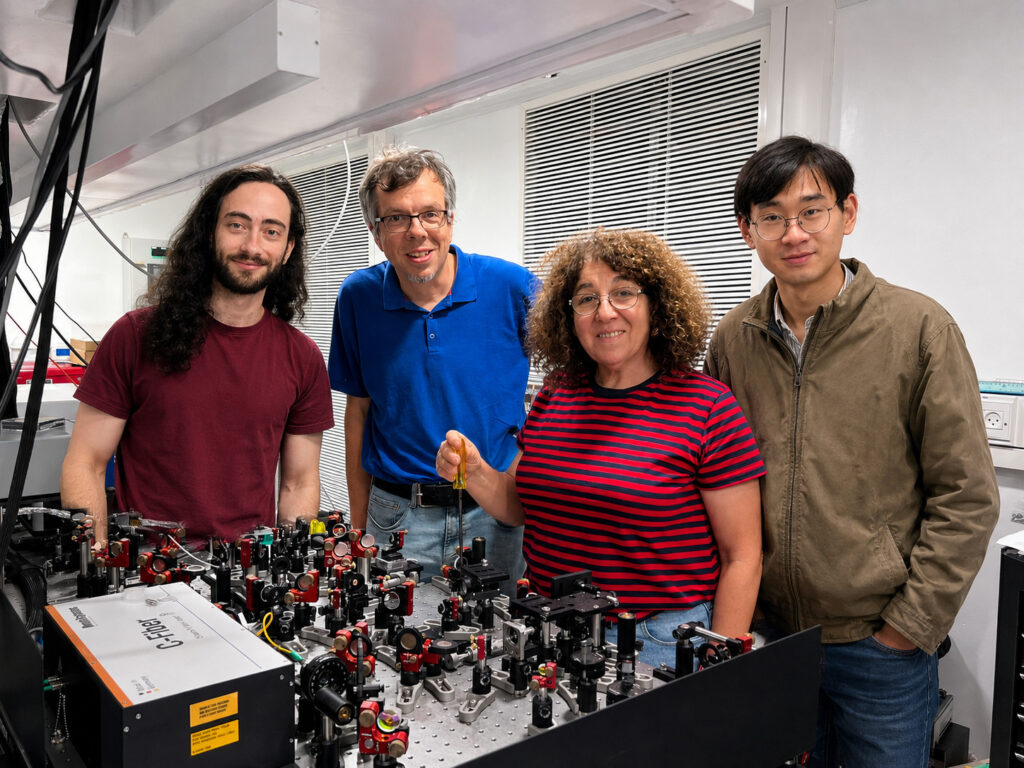

In our new study, now published in Nature Photonics, we have combined attosecond temporal control with nanometer-scale imaging in a scanning tunneling microscope (STM), bringing the goal of observing electron motion in real space and real time substantially closer. With this advance, we have realized a main goal of our ERC project ATTIDA.
Our team managed to control the direction of ultrafast electron currents across a nanometer-sized STM junction. We illuminated the junction with specially sculpted infrared laser pulses consisting of two colors. By adjusting the relative timing of the colors, we reshaped the electric-field waveform and smoothly switched the current between tip-to-sample and sample-to-tip transport. Free from thermal artefacts, we demonstrated a lateral spatial resolution of about 2 nm and sensitivity to height variations below one ångström under ambient conditions.
We compared our measurements with several theoretical models, we identified a three-step transport mechanism: the light field thins the tunnelling barrier and releases an electron, accelerates it across the junction, and transmits it into the sample. Our calculations constrain each current burst to only 860 attoseconds. In the future, single-cycle pulses could generate isolated bursts with controlled timing and direction, potentially enabling atomic-scale movies of coherent electron-hole and many-body dynamics and opening a route towards lightwave electronics operating far beyond gigahertz frequencies.