

Spins associated with impurity donors in semiconductors typically exhibit very long coherence times, making them excellent candidates for reliably storing quantum information. Superconducting qubits, by contrast, offer strong scalability and straightforward control, enabling fast and efficient quantum gate operations.
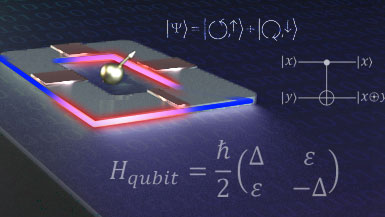
We develop hybrid quantum architectures that combine these two complementary platforms. Our goal is to create a quantum interface that stores quantum information in the long-lived spin states while using the superconducting circuit as a versatile quantum bus for mediating interactions and enabling coherent control.
To achieve this, we enhance the magnetic coupling to the spins by employing a highly nonlinear superconducting circuit with large quantum current fluctuations, which acts as a local magnetic antenna.
Read more
- Controlling spin relaxation with a cavity, A. Bienfait J.J. Pla, Y. Kubo, X. Zhou, M. Stern; C.C. Lo; C.D. Weiss, T. Schenkel, D. Vion; D. Esteve; J.J.L. Morton & P. Bertet, Nature, 531, 74-77 (2016).
- Coupling a single Nitrogen-Vacancy center to a superconducting flux qubit in the far-off resonance regime, T Douce, M. Stern, N. Zagury, P. Bertet and P. Millman, Physical Review A. 92, 052335 (2015).
- Coherence properties of a spin in a squeezed resonator, I. Shani, E. Dalla Torre & M. Stern, Physical Review A. 105, 022617 (2022).
- Strong coupling of a superconducting flux qubit to single bismuth donors, T. Chang, I. Holtzman, S. Q. Lim, D. Holmes, B. C. Johnson, D. N. Jamieson and M. Stern, Nature Communications 16, 9832 (2025).