
Laser-driven ICF relies on using a large set of high-power laser beams in order to deposit energy in a Deuterium-Tritium fuel, such that it is compressed and heated to the point of fusion ignition. In the quest for optimized performance of ICF, improvement can be sought in many areas, which is where basic science investigations are needed. One basic science question is related to laser-plasma coupling.
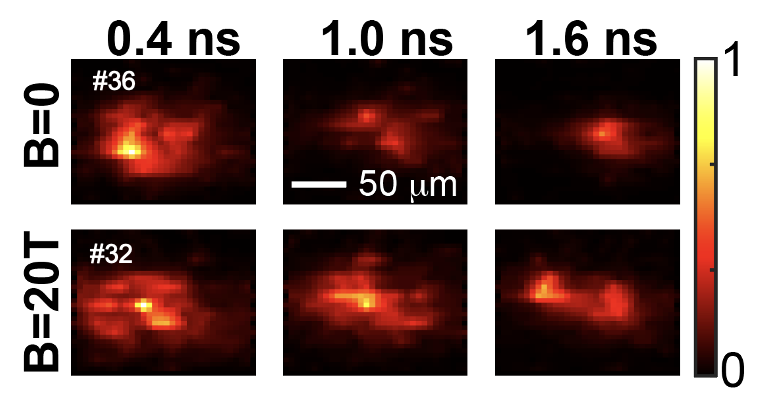
We currently work on investigating the fundamental issue of light transport (impacting laser-plasma instabilities, laser propagation, and laser exchange effects) in magnetized turbulent plasmas, understanding the hydrodynamics of new target concepts for fusion, as well as testing new strategies to mitigate energy losses to instabilities in plasmas.
Our recent work on light transport in magnetized turbulent plasmas is presented in “Dynamics of Nanosecond Laser Pulse Propagation and of Associated Instabilities in a Magnetized Underdense Plasma”, while another recent study on laser coupling in plasmas is described in “Investigation of Laser Plasma Instabilities driven by Coupled High-Power Laser Beams in Magnetized Underdense Plasmas”.